In Upstate South Carolina, mold is not just a “bathroom problem.” Between high humidity, heavy seasonal rain, crawl-space construction, and the occasional storm-related leak, mold can show up in places homeowners don’t think to check—behind drywall, under flooring, inside HVAC components, and throughout damp crawl spaces.
This guide expands “5 simple ways” into a complete, practical detection playbook for homeowners across Greenville, Greer, Spartanburg, Easley, Taylors, Five Forks, Simpsonville, Travelers Rest, and nearby communities. You’ll learn what to look for, where mold hides most often, which tools can help confirm moisture, when testing makes sense, and what to do next if you find mold.
Important: Mold can begin growing quickly after water intrusion. The key is early detection and moisture control—not just surface cleanup.
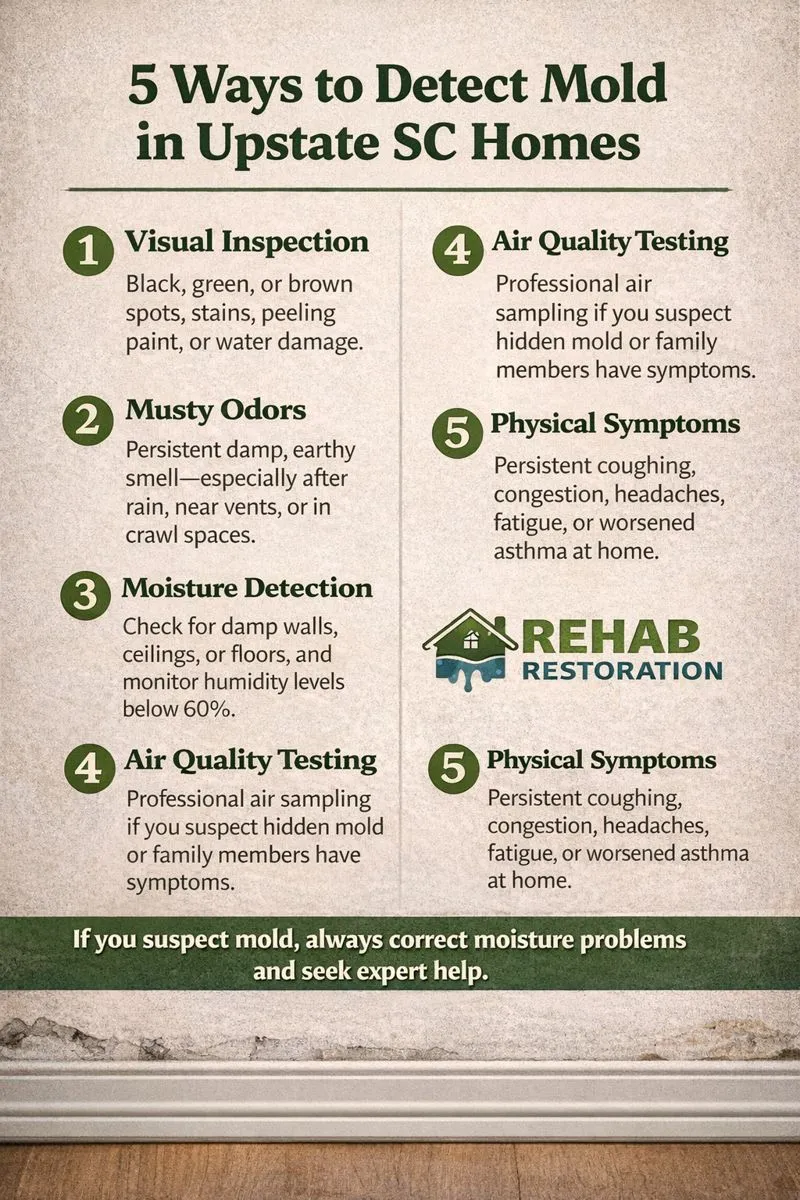
Click to Enlarge
Mold needs two things to thrive: moisture and organic material (like wood framing, drywall paper backing, insulation, carpet padding, dust, and debris). Upstate South Carolina checks both boxes for much of the year.
Local conditions that make mold more likely include:
If your home has had any water issue—roof leak, plumbing leak, burst pipe, wet crawl space, or storm intrusion—mold detection should become part of your routine. For water-related warning signs, this post pairs well with Signs You Need Professional Water Mitigation and Most Common Water Damage Issues in Greenville County.
A visual inspection is the simplest place to start, but the goal isn’t only to find “black spots.” It’s to find the moisture damage patterns that signal mold might be growing out of sight.
If crawl spaces are part of your home’s layout, it’s worth reading Why Crawl Spaces in South Carolina Get So Moldy—it connects the “why” to the practical fixes. If you’re already seeing growth under the home, Crawl Space Mold Removal in Upstate SC offers a more direct next step.
Mold is often discovered because a home develops a persistent, earthy odor—especially after rain or when the HVAC runs. A musty smell can be one of the strongest indicators of hidden mold because odor compounds can travel through walls, floors, and ductwork even when growth isn’t visible.
If odor is your main symptom (especially after a fire), you may also want to review How to Eliminate the Smell of Smoke After a Fire and Smoke Damage After Fire: Causes and Restoration Tips. Odor issues often overlap with humidity and ventilation problems.
Mold follows moisture—so if you can find moisture, you can usually find the mold risk. Moisture detection is also one of the best ways to spot trouble before visible growth appears.
If moisture came from a leak or flood event, these resources support next steps: Water Leak Repair in Greenville, Basement Water Damage, and Emergency Water Cleanup in Upstate SC.
Air sampling and other testing can be helpful in specific situations, but it’s important to understand what indoor mold testing does well—and where it can be misunderstood. In many real-world cases, the most important discovery is not “what species is it,” but where moisture is coming from and how far growth has spread.
For homeowner-facing guidance on mold cleanup and moisture control, the U.S. Environmental Protection Agency has a widely referenced resource: A Brief Guide to Mold, Moisture and Your Home (EPA). For professional standards that guide remediation work practices, the industry references the IICRC S520 standard: IICRC S520 Mold Remediation Standard.
Sometimes the first “clue” is not a stain or odor—it’s a pattern. Mold exposure affects people differently, and symptoms can overlap with seasonal allergies. But if symptoms worsen at home, improve when away, or appear after a leak or storm event, mold should be part of your evaluation.
For health-focused guidance on mold exposure and damp environments, the CDC provides a clear overview here: CDC: Mold and Health.
Note: If you’re experiencing health symptoms, seek medical guidance. From a home perspective, the most actionable step is to identify moisture and remove the growth safely and correctly.
If you’ve checked the obvious places and still suspect mold, focus on hidden areas. In Upstate South Carolina, these are the repeat offenders:
If crawl space moisture is part of your situation, you may also want to compare solutions in Crawl Space Encapsulation vs. Vapor Barrier and read Does Crawl Space Encapsulation Add Value to a Home? for longer-term planning.

Mold inside walls is harder to confirm because it can grow undisturbed in insulation and drywall paper backing. In many cases, the growth is not visible until moisture has been present long enough to cause staining, warping, or odor.
If wall moisture came from a roof issue, this guide can help homeowners connect the dots: Roof Leak Detection and Repair in Upstate SC.
“Black mold” is often used as a catch-all phrase for dark-colored growth. One type commonly discussed is Stachybotrys chartarum, which is associated with prolonged moisture exposure on cellulose-rich materials like drywall and wood. Color alone does not confirm species, but dark growth in persistently wet areas should be taken seriously.
If you suspect black mold in Greer specifically, you can also internally link to Black Mold Removal in Greer, SC.
One of the biggest issues we see is homeowners trying a quick DIY cleanup that removes surface staining but leaves the underlying moisture and contaminated materials in place. That leads to repeat growth—and often a larger spread.
If your mold concerns started after water intrusion or flooding, these posts connect the “detect” phase to the “restore” phase: Flood Repair in Upstate South Carolina and What Should I Do If I Think My Home Has Water Damage?.
Prevention is mostly moisture control. If Upstate SC humidity is the constant, your goal is to reduce the conditions that allow dampness to linger.
For crawl space strategy specifically, consider linking readers to Vapor Barriers in South Carolina Homes and Crawl Space Encapsulation Services.
You should consider professional help when:
If you want a direct path for readers who are ready for help, internal links that match this stage well include Mold Removal in Upstate South Carolina, Crawl Space Mold Removal, and location-specific options like Mold Removal in Greenville, SC or Mold Removal in Spartanburg.
Look for persistent musty odors, bubbling paint, peeling wallpaper, soft drywall, or discoloration that grows over time—especially after a plumbing leak or roof issue. In Upstate South Carolina, hidden mold often develops in wall cavities when moisture gets trapped and doesn’t dry quickly. Moisture meters and infrared cameras can help confirm risk areas.
Not always, but musty odors are one of the most common clues of hidden mold. If the smell is stronger after rain, in humid weather, or when the HVAC runs, it’s worth inspecting crawl spaces, plumbing walls, and areas with past water damage.
Yes. High humidity and condensation can create enough moisture for mold growth over time, especially in poorly ventilated bathrooms, damp crawl spaces, and areas with temperature differences that cause moisture to collect on surfaces.
Mold can begin growing quickly when materials remain wet. The best prevention is fast drying and moisture control after any leak, flood, or storm intrusion. If you’re dealing with a recent event, see Emergency Water Cleanup in Upstate SC.
In many cases, visible mold plus a clear moisture source is enough to act. Testing can be useful when you can smell mold but can’t find it, when documentation is needed, or when you want a baseline before/after remediation. The most important step is correcting moisture and removing affected materials safely.
DIY kits can sometimes confirm that spores exist (which is common in many indoor environments), but they often don’t pinpoint the source or severity. A professional inspection focuses on moisture mapping and identifying where growth is active—so the underlying problem can be solved.
Bleach may remove surface staining on non-porous surfaces, but it does not reliably eliminate mold embedded in porous materials like drywall, wood, and insulation. In many cases, the underlying issue is moisture—so removal and drying are more important than surface treatment alone. The EPA emphasizes moisture control and appropriate cleanup steps for home mold situations.
Crawl spaces, behind bathroom walls, under sinks, around windows, attics near venting, and HVAC components are common hiding spots. If you want a crawl-space-focused breakdown, see Why Crawl Spaces in South Carolina Get So Moldy.
It can. Mold spores can impact indoor air quality even when growth is hidden. If symptoms worsen at home and improve when away—especially after a water event—mold should be considered as part of the home evaluation. For general health information, the CDC provides guidance on damp environments and mold exposure.
If mold is widespread, recurring, located in crawl spaces or walls, linked to water damage, or tied to persistent odors or symptoms, it’s time to call a professional. You can learn more about next steps at Mold Removal in Upstate South Carolina or Crawl Space Mold Removal.
Detecting mold is only the first step. The long-term solution is always the same: remove the affected materials safely and fix the moisture source so the problem does not return. If you’re seeing signs of crawl space mold, leaks, or storm-related moisture, Rehab Restoration can help you identify the source and move toward a clean, dry home environment.