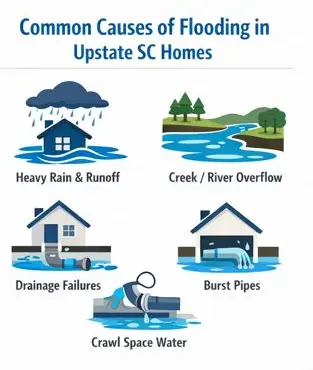
Flooding in the Upstate often comes from heavy rain, saturated soil, drainage issues, or indoor water events that spread quickly.
If you’re researching flood repair in Upstate South Carolina, you’re likely trying to understand what steps actually matter—and which ones prevent repeat damage later.
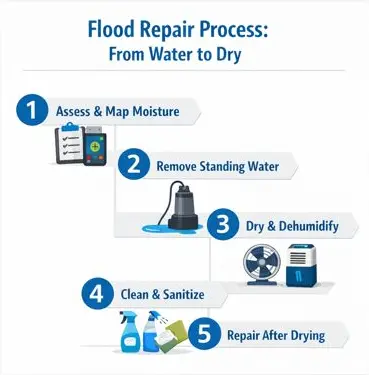
This guide explains flood repair the same way restoration professionals approach it: protect safety, stop the water source, remove standing water, dry the structure fully, confirm moisture levels, then repair finishes.
It focuses on flood restoration, flood damage repair, and flood damage restoration from an informational, homeowner-first perspective.
For storm-related scenarios common in this region, start with: what to check for after a storm in South Carolina.
Flood damage in the Upstate isn’t limited to rivers overflowing.
Many homes experience flooding from fast runoff, poor drainage, sump pump failures, crawl space water intrusion, or water entering through garages.
Indoor events—like burst pipes—can create similar conditions when water spreads under flooring or between rooms.
If your flooding began indoors, these guides provide helpful context: what to do after a burst pipe and emergency vs non-emergency water damage.
Basement flooding requires a slightly different approach: basement water damage.
Before cleanup begins, check for electrical and structural concerns.
If water contacted outlets, appliances, HVAC equipment, or the breaker panel, proceed carefully and get guidance.
FEMA’s cleanup safety guidance: cleaning and sanitizing after an emergency.
Roof-related water entry often requires targeted diagnosis: roof leak detection in Upstate SC.
Take wide photos of affected rooms and close-ups of water lines, damaged materials, and contents.
Clear documentation helps track decisions and supports insurance conversations if needed.
A home can appear dry long before it actually is.
True flood restoration focuses on returning materials to safe moisture levels—not just removing visible water.
For local patterns, see: most common water damage issues in Greenville County.
Checklist-style overview:
water damage dos and don’ts.
Timely drying limits secondary damage such as swelling, warping, corrosion, and lingering humidity.
The goal is organized, methodical action—not rushed decisions.
EPA moisture and mold guidance: EPA mold resources.
Drying is often the most important phase.
Air movement alone is not enough—humidity must be reduced so moisture can leave building materials.
Crawl space moisture is a common local factor: vapor barriers in South Carolina homes.
Flood damage repair begins only after drying goals are met.
Some materials can be restored; others must be removed to allow the structure to dry correctly.
If you suspect moisture remains:
what to do if you think your home has water damage.
Emergency response overview: emergency restoration services.
Flood restoration stabilizes the environment through drying and moisture control.
Flood repair is the rebuild phase—drywall, flooring, trim, and finishes.
Not always, but it usually indicates moisture is still present somewhere in the structure.
Maintain gutters and downspouts, ensure grading slopes away from the home, keep drains clear, and inspect after storms.
Related guide: storm damage property checklist.