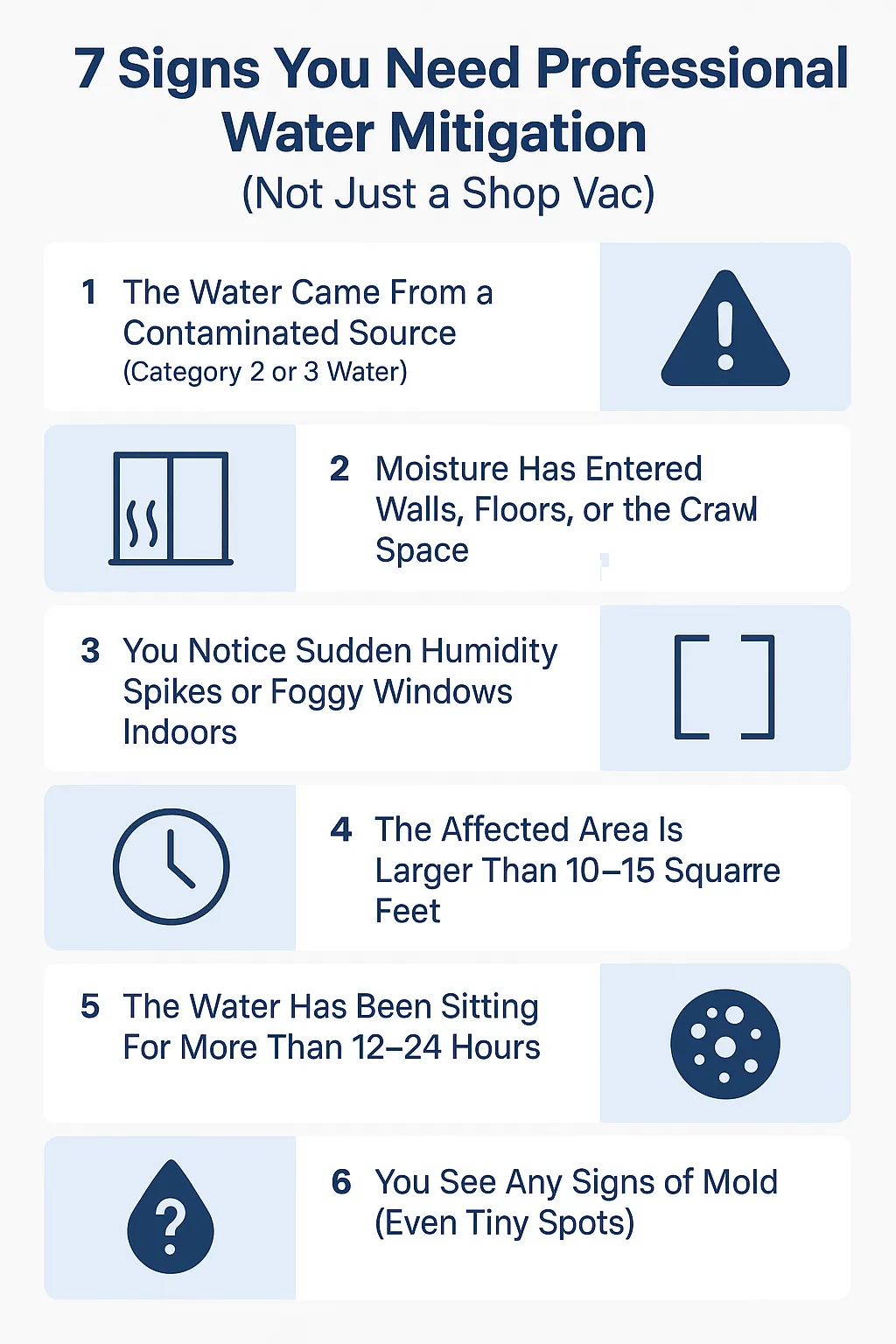
7 Signs You Need Professional Water Mitigation (Not Just a Shop Vac)
For Homeowners in Upstate South Carolina
When water gets into your home—whether from a burst pipe, a leaking appliance, heavy rain, or a flooded crawl space—every minute matters. Many homeowners try to fix the issue with a shop vac or a few towels, thinking the problem is contained once the visible water is gone. Unfortunately, what you see is only a small fraction of the damage happening behind the scenes.
Professional water damage cleanup is more than just removing standing water. It’s a technical process rooted in IICRC standards that includes moisture detection, structural drying, sanitation, mold prevention, and damage stabilization. In a humid region like Upstate South Carolina—where crawl spaces, clay-heavy soil, and rapid weather swings create the perfect environment for hidden moisture—DIY cleanup often leads to larger issues within hours.
If you’re dealing with water damage in Greenville, Mauldin, Easley, Simpsonville, Greer, Travelers Rest, Spartanburg, Anderson, Pickens County, or anywhere in the Upstate, here are the seven signs that it’s time to call certified professionals instead of relying on a shop vac.
The Water Is Coming From a Contaminated Source
Not all water is safe to clean up on your own. Any time water contains contaminants—or may have touched a contaminated surface—it requires professional mitigation.
The IICRC Categories of Water Damage
Understanding the type of water involved determines the entire restoration plan:
Category 1: Clean Water
Source: burst supply lines, sink overflow, appliance malfunctions. This is the only type of water that might be safe for DIY cleanup—but even then, only if the spill is extremely small and caught early.
Category 2: Grey Water
Source: washing machine drain lines, dishwasher leaks, overflows from utility sinks, and similar sources. This water contains detergents, soil, bacteria, and chemicals.
Category 3: Black Water
Source: sewage backups, toilet overflows, and floodwater entering from outside. This type of water is a known health hazard requiring full protective equipment and antimicrobial treatment.
Why This Matters in Upstate SC
Many homes in the Greenville–Spartanburg–Anderson region are older, with aging drain lines that frequently back up or crack. Stormwater intrusion during heavy rains is also common, especially in neighborhoods with clay-dense soil that prevents proper drainage. Any water touching soil, drainage lines, HVAC condensate lines, or crawl space debris becomes Category 2 or 3 instantly.
A shop vac cannot safely remove or sanitize contaminated water. If you’re unsure whether the water is clean, it’s a sign to call a professional for fast water mitigation services immediately.
The Water Has Spread Into Walls, Floors, or the Crawl Space
Water moves quickly. Even a small pool on the floor can wick upward into drywall or seep downward into your crawl space within minutes. By the time most homeowners notice damage, the saturation has already spread far beyond the visible area.
Once water enters materials like:
- drywall
- insulation
- subflooring and joists
- baseboards and sill plates
- carpet and padding
- the soil and structure in the crawl space
it requires industrial-grade drying equipment to remove it.
Why This Is Critical in the Upstate
Upstate South Carolina is known for high summer humidity, older construction, widespread crawl space foundations, and clay-heavy soil that traps moisture. Together, these create a moisture-rich environment where water easily spreads and stays hidden. Even if you remove surface water, the materials inside your home may still be saturated.
In many cases, the best long-term solution includes both water mitigation and crawl space encapsulation to prevent humidity and moisture from returning later.
Ignoring moisture inside walls or under floors leads to structural deterioration, odors, and mold growth in days—not weeks.
You Notice Sudden Humidity Spikes Inside Your Home
If your home suddenly feels damp, muggy, or “off,” it’s a sign that water is evaporating inside your structure. Most people notice symptoms before they notice the source.
Common Indoor Signs
- High humidity readings on thermostats or hygrometers
- Foggy windows
- Musty odors
- Air conditioning running nonstop
- A noticeable heaviness in the air
These symptoms mean water has soaked into building materials and is releasing moisture into the air—something that cannot be fixed with a shop vac.
Why This Happens Fast in Upstate South Carolina
Greenville, Spartanburg, and surrounding areas routinely experience outdoor humidity between 70% and 90% during much of the year. When indoor humidity rises above outdoor humidity, evaporation is occurring inside the home, often from:
- a leak behind a wall
- a saturated crawl space
- wet insulation
- wet carpet padding
- moisture under vinyl or laminate flooring
High humidity accelerates mold growth, meaning professional drying and, when needed, crawl space moisture control are essential to restore safe moisture levels.
The Damaged Area Is Larger Than 10–15 Square Feet
According to IICRC standards, any water-damaged area larger than 10 square feet requires professional mitigation. That’s roughly the size of a small bathroom rug.
When water spreads beyond that:
- multiple layers of materials are involved
- moisture travels vertically and horizontally
- structural inspection becomes necessary
- air movers and LGR dehumidifiers must be used
- moisture mapping is required to track drying progress
This Is Especially True in Upstate Crawl Spaces
In areas like Taylors, Mauldin, Simpsonville, and Easley, many homes sit on open or vented crawl spaces. When water enters, it rarely affects only a small area. Moisture can travel the entire length of the crawl space, creating:
- wet joists
- condensation on ductwork
- microbial growth
- wood rot
- sagging insulation
- long-term foundation damage
Trying to clean a large area with household tools often makes the problem worse, not better. For widespread damage, full
water damage restoration in South Carolina is the safer and more effective approach.
The Water Has Been Sitting for Over 12–24 Hours
Time directly impacts water damage severity. The longer moisture sits, the deeper it penetrates.
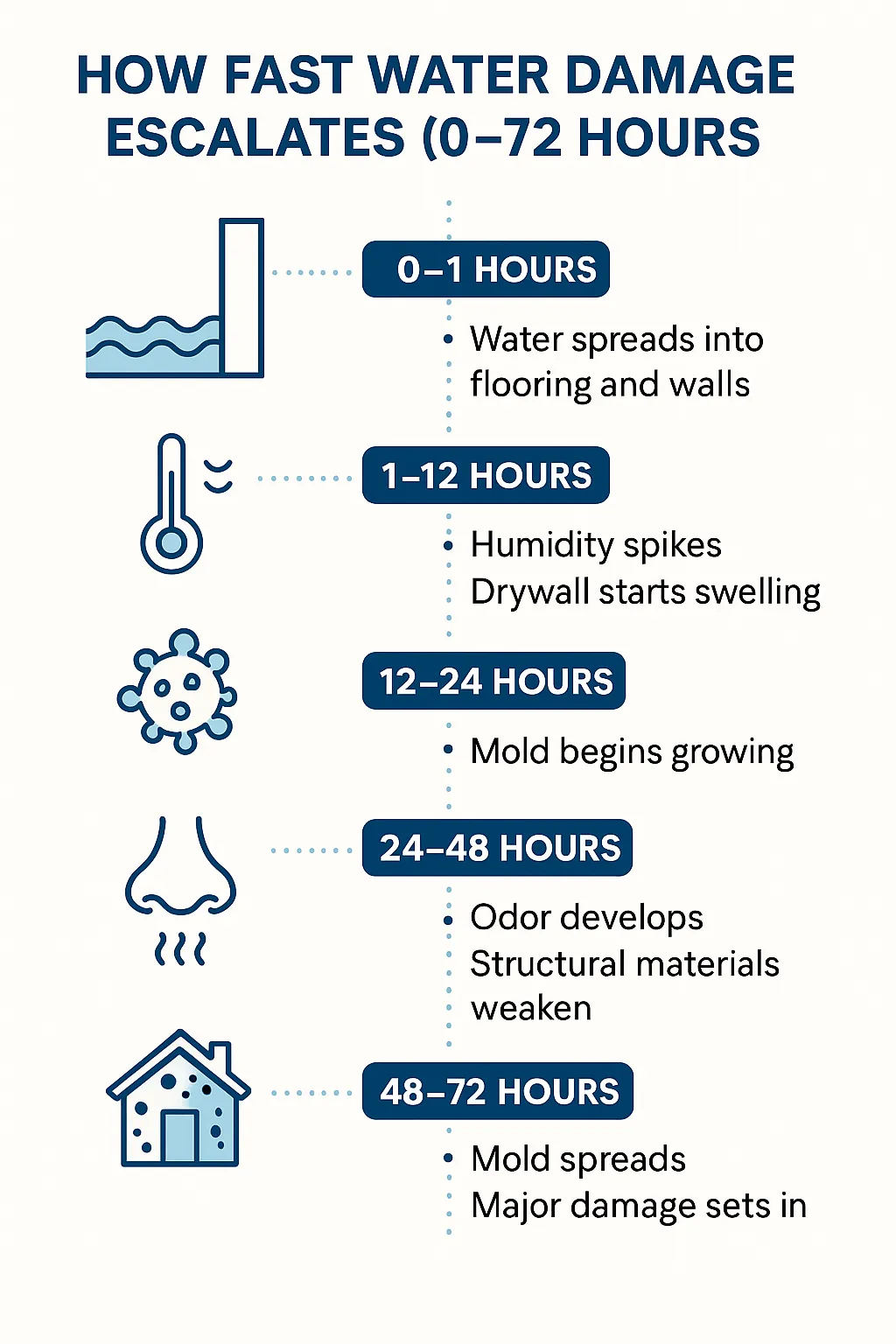
Water Damage Timeline (Based on IICRC Studies)
Within Minutes
- Water spreads across floors and reaches walls
- Wood begins absorbing moisture
Within Hours
- Drywall begins to swell
- Odors begin forming
- Furniture starts absorbing water
Within 24 Hours
- Mold begins colonizing
- Bacteria begins multiplying
- Materials start breaking down
Within 72 Hours
- Severe structural damage may begin
- Drywall can become structurally unsalvageable
- Mold spreads to new rooms
Accelerated Damage in Upstate SC
High humidity accelerates every step of the timeline. In Greenville and Spartanburg, mold can form in as little as 8–12 hours, especially in warmer months.
If you discover water that’s been sitting overnight, or the leak began while you were away, professional
emergency water extraction is no longer optional—it’s required.
You See Any Signs of Mold (Even Small Spots)
Mold grows quickly when moisture is present—and some spores only need a few hours to start spreading. If you see any signs of mold after water intrusion, professional remediation is needed.
Early Signs of Mold Growth
- Musty or earthy smell
- Tiny black, green, or white spots on walls or baseboards
- Discoloration of carpet or flooring
- Warped trim or bubbling paint
- Odor or visible growth in the crawl space
- Increased allergy symptoms for people in the home
Why Upstate Homes Are Prone to Mold
Upstate South Carolina is one of the most humid mountain-adjacent regions in the Southeast. Between wet winters, humid summers, and dense tree coverage in areas like Travelers Rest, Pickens, and Salem, moisture issues are extremely common.
Once mold begins growing, the contaminated materials often require removal. A shop vac cannot dry, sanitize, or contain mold spores. At this point, delaying professional mitigation only increases the damage—and the cost.
You Don’t Know Where the Water Came From (or If It’s Still Leaking)
One of the biggest risks of DIY cleanup is assuming the source of the water is obvious. In reality, most leaks come from hidden or unexpected sources.
Common Hidden Water Sources in Upstate Homes
- Cracked or aging copper pipes
- Pin-hole leaks behind walls
- HVAC condensate line backups
- Overflowing drip pans in attics
- Crawl space condensation
- Foundation seepage during heavy rain
- Roof leaks running behind walls
- Faulty water heater valves
- High soil moisture around foundations
If you’ve cleaned up water but don’t know exactly why it happened—or whether it may happen again—it’s time to call professionals.
How Professionals Diagnose the Source
Certified mitigation companies use tools like thermal imaging cameras, moisture meters, hygrometers, leak detection tools, and thorough crawl space inspections to pinpoint the exact source of the intrusion and verify that it’s no longer active.
A shop vac can remove water—but it can’t stop the problem from returning. That’s where full-service water restoration comes in.
Why DIY Cleanup Fails in Upstate South Carolina
Even motivated homeowners with the right tools cannot match the thoroughness of professional mitigation—especially in a region with humidity and soil conditions like ours.
DIY Cleanup Often Fails Because:
- Household fans don’t deliver enough airflow for structural drying
- Shop vacs only remove surface water
- Insulation and drywall remain saturated
- Wet crawl space soil cannot be vacuumed
- Moisture remains trapped inside wall cavities
- Mold begins growing unseen
- Structural wood absorbs moisture for days
- No antimicrobial treatment is applied
- Drying progress is not monitored with meters
- No documentation is created for insurance purposes
Professional mitigation isn’t about being “extra cautious”—it’s about preventing major structural and health hazards that build over time.
What Proper Water Mitigation Includes
When you call a certified team like Rehab Restoration, the process goes far beyond water removal. It can include:
- Identifying and stopping the water source
- Categorizing the water (Category 1, 2, or 3)
- Extracting standing water from floors and carpets
- Removing moisture from enclosed spaces and structural materials
- Removing non-salvageable materials when needed
- Setting high-velocity air movers
- Using LGR or desiccant dehumidifiers
- Applying antimicrobial treatments
- Moisture mapping to document drying progress
- Checking crawl spaces, attics, and wall cavities
- Taking steps to prevent mold before it starts
This is why insurance companies prefer professional mitigation—because it prevents future claims and more serious damage down the road.
Local Water Mitigation Challenges Unique to Upstate SC
Upstate homes face moisture issues that don’t exist in many other regions. This makes DIY cleanup even riskier.
1. Crawl Spaces
Most homes in the Upstate have crawl spaces, which are notorious for wood rot, trapped humidity, mold growth, standing water from storms, condensation on ductwork, and sagging insulation. Water rarely stays in one area—meaning a small visible leak may have caused large crawl space damage.
2. Clay-Dense Soil
From Spartanburg to Anderson, the soil is heavy in clay, preventing water from draining effectively. This leads to:
- Foundation seepage
- Standing water around homes
- Water intrusion after storms
- Crawl space flooding
3. Rapid Weather Swings
Thunderstorms, hurricanes, heavy rain, and sudden freezes create a constant cycle of burst pipes, stormwater intrusion, foundation pressure, and roof leaks.
4. Older Plumbing Systems
Homes built 20–60 years ago still rely on aging copper plumbing, cast iron drain lines, and older HVAC systems. These are all common sources of recurring water damage that require more than a quick cleanup.
When in Doubt — Call a Professional Early
Shop vacs have their place—quick cleanups, small spills, and nuisance water. But the moment water touches structural materials, becomes contaminated, or sits for more than a few hours, professional mitigation is the only safe path.
The cost of improper DIY cleanup can be massive:
- Mold remediation
- Structural repairs
- Flooring and drywall replacement
- Crawl space restoration
- Insurance claim denial
Calling a certified restoration company early prevents these long-term issues and can save homeowners thousands.
Need Fast, Professional Water Mitigation in Upstate South Carolina?
Rehab Restoration is your local, certified team for water damage cleanup, mitigation, mold prevention, and crawl space moisture control.
We Proudly Serve Homeowners Throughout:
Greenville, Simpsonville, Mauldin, Greer, Easley, Travelers Rest, Taylors, Spartanburg, Anderson, Pickens, Oconee County, and the surrounding Upstate communities. We also provide property damage restoration in Travelers Rest and nearby areas when storms, leaks, or plumbing failures strike.
You’ll Get:
- Fast response times
- IICRC-certified professionals
- Advanced extraction and drying equipment
- Crawl space and moisture experts
- Complete moisture inspection and documentation
- Mold-prevention treatments
- Transparent communication from start to finish
When water threatens your home, you don’t need a shop vac — you need a team that knows how to protect your property from long-term damage.
Call Rehab Restoration today at
(864) 884-2949
or
contact our team
for emergency service and professional water mitigation in Upstate South Carolina.