(And How to Fix It)
Crawl spaces across Upstate South Carolina face some of the toughest moisture conditions in the country. Between high humidity, red clay soil, heavy storms, and older vented-crawl construction, it’s common for homeowners to find mold on floor joists, insulation, and ductwork—even if there’s no standing water. The good news: you can stop it and prevent it for good once you understand what’s causing the problem.
Below, we break down why crawl spaces in Greenville, Spartanburg, Anderson, and surrounding areas get so moldy, what it means for your home, and how to fix moisture issues the right way.
Click to Enlarge
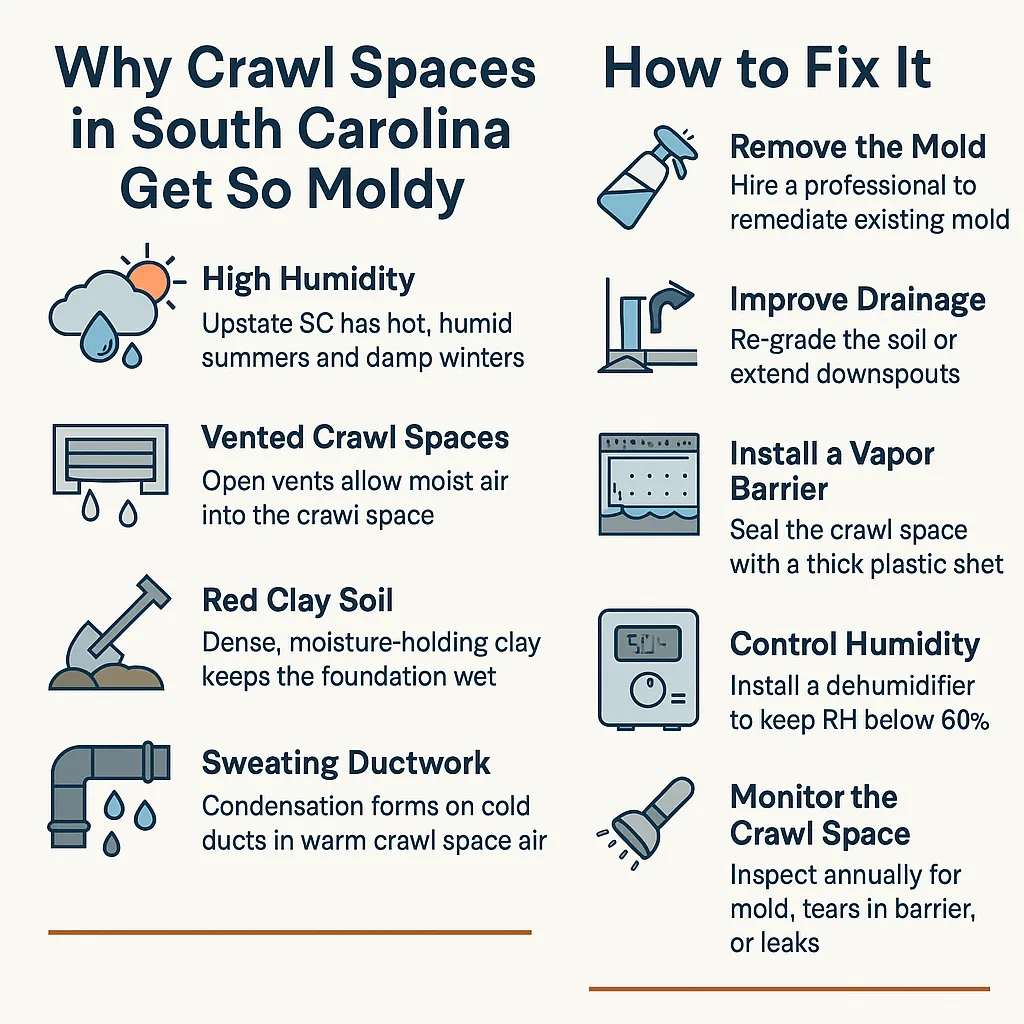
Upstate South Carolina sits in a humid subtropical region, where summer temperatures climb into the upper 80s and dew points regularly reach muggy levels. Even in cooler months, average humidity stays around 60–65%. When that warm, moist outdoor air slips into a shaded, cooler crawl space, condensation forms on wood framing, ductwork, insulation, and pipes.
This is why many homeowners see mold growth even when they never notice puddles or leaks—the crawl space air simply stays too damp for too long. Once relative humidity climbs past 60%, mold has everything it needs to grow on wood, dust, and organic debris under the home.
If you’re already smelling musty odors or seeing spots on wood, it’s a good time to schedule a crawl space inspection with a local expert like Rehab Restoration’s mold removal team.
Crawl spaces in Upstate South Carolina don’t behave like those in cooler or drier parts of the country. Our region has:
Put together, that means crawl spaces here tend to stay damp longer and need more deliberate moisture control to stay mold-free.
Many homes built from the 1970s through the early 2000s in Upstate SC were constructed with open foundation vents. The idea was that warm air would circulate and dry the crawl space. In humid climates like ours, the opposite happens.
Warm, humid summer air enters through the vents → hits cooler surfaces → turns into moisture → feeds mold.
Instead of drying the space, vents allow a constant supply of moisture to enter. Homeowners often notice:
In Upstate SC, relying on vents is one of the main reasons crawl spaces stay damp year-round.
Much of Greenville, Spartanburg, and Anderson is built on red clay soil—dense, slow-draining, and moisture-retentive. After heavy rain, clay absorbs water, swells, and holds moisture against the foundation for long periods. Even when the surface looks dry, the soil below your crawl space may still be releasing moisture into the air.
Homes built in neighborhoods with heavier clay pockets often battle:
If you’ve had repeated moisture or foundation issues, consider pairing mold remediation with moisture control and crawl space improvements. You can learn more about Rehab Restoration’s water damage restoration services in Upstate SC here.
Many older homes have a simple 6-mil plastic sheet laid loosely on the ground. Over time, these barriers tear, shift out of place, or fail to cover the full soil surface—allowing soil moisture to evaporate straight into the crawl space.
A vapor barrier only works when it’s:
If your vapor barrier is thin, ripped, or incomplete, moisture is constantly entering the crawl, raising humidity and feeding mold growth. For a deeper look at how a proper barrier should work, visit our page on vapor barrier installation in Greenville, SC.
Upstate SC summers create huge temperature differences between cold AC ducts and humid crawl space air. When warm air touches cold metal, it condenses instantly—just like a cold drink sweating outside in July.
This leads to:
Even if your crawl space dirt looks “dry,” sweating ducts can raise humidity enough to support mold growth.
Most older Upstate SC homes have fiberglass batts installed between floor joists. Over time, these materials absorb condensation, sag, and trap moisture against wood. This makes mold growth even more likely and can eventually lead to soft subfloors or sagging floors above.
A damp crawl space doesn’t stay “just a crawl space problem” for long. As humidity and mold build up, homeowners often experience:
The longer humidity sits above 60%, the more damage it can cause—and the more expensive the repairs become.
If you’re already seeing any of these warning signs, it may be time to request a crawl space moisture inspection with Rehab Restoration.
Stopping crawl space mold requires fixing both the moisture and the environment. Here’s the process recommended by building-science experts and Upstate SC restoration professionals.
If you already see visible mold on wood, insulation, or ductwork, professional remediation is the safest option. DIY surface cleaners rarely stop mold from returning because the moisture problem remains.
Rehab Restoration provides full mold removal in Upstate South Carolina to treat the source, clean the structure, and prevent regrowth.
If water pools under your home during storms—or if grading slopes toward the foundation—moisture will keep cycling into your crawl space.
Common solutions include:
Stopping water intrusion is the first step toward a permanently dry crawl space.
A modern vapor barrier should be thick, reinforced, and sealed across the entire crawl space. Many Upstate homes also benefit from full encapsulation, which includes sealing vents, insulating foundation walls, and creating a controlled environment.
Learn more about proper moisture control here:
Vapor Barrier Installation in Greenville, SC
Encapsulation is especially effective in high-humidity neighborhoods or homes with ongoing mold problems. For homes with more extensive issues, Rehab Restoration can also coordinate with trusted partners for full crawl space encapsulation solutions.
Even with encapsulation, crawl spaces need ongoing humidity control. A crawl-space-rated dehumidifier keeps relative humidity below 60%, preventing mold and protecting the home’s structure long-term.
This is the step many homeowners forget—and it’s the one that keeps mold from coming back.
Annual inspections help catch:
With proper maintenance, a crawl space can stay mold-free for decades.
In most South Carolina policies, mold caused by long-term humidity or neglected moisture problems is not covered. Insurance typically only helps when mold results from a covered water event—such as a burst pipe or sudden appliance failure.
If you suspect a covered event caused water damage, Rehab Restoration also provides:
Water Damage Restoration in Upstate SC
You should reach out to a professional if you notice:
These signs usually point to a moisture problem that will not go away without proper remediation and crawl space improvements.
Schedule a crawl space evaluation with Rehab Restoration if any of these issues sound familiar.
Crawl space mold can show up anywhere in Upstate South Carolina, but certain areas and home styles tend to see problems more often:
Even if your neighborhood isn’t listed, the same conditions—humidity, red clay soil, and vented crawl spaces—can create the perfect environment for mold anywhere in Upstate SC.
Yes. In humid areas like Greenville, Spartanburg, Anderson, Simpsonville, and surrounding communities, mold in vented crawl spaces is very common. High summer humidity, red clay soil that holds moisture, and older construction practices all combine to keep crawl spaces damp. The key is not to panic—but to address moisture and mold promptly so it doesn’t damage your home or impact indoor air quality.
Even if you don’t see mold inside the living areas, a moldy crawl space can still affect your home. Air naturally moves upward through the house, which means some crawl space air can be pulled into your living space. Over time, this can lead to musty odors, increased allergens, and potential wood rot in floor joists and subfloors. It’s worth having a professional inspection if you suspect mold or notice a persistent damp smell.
In Upstate South Carolina’s humid climate, opening vents usually makes crawl space moisture worse, not better. Warm, humid outside air enters the cooler crawl space, condenses on wood and ductwork, and raises humidity into the mold-growth range. Modern building science—and current code options in South Carolina—favor sealed or encapsulated crawl spaces with controlled ventilation or dehumidification rather than relying on open vents.
Spraying bleach or store-bought cleaners on mold in a crawl space may lighten staining, but it doesn’t solve the root cause. If humidity stays high or water keeps entering the area, mold can return and hidden wood damage may continue. Safe, effective remediation usually involves: identifying the moisture source, removing or cleaning contaminated materials, and improving the crawl space environment with vapor barriers, drainage, and humidity control.
Costs vary based on the size of your crawl space and how much damage or moisture is present. Minor mold cleanup and basic improvements are on the lower end, while full crawl space encapsulation with drainage and dehumidification can run into the thousands of dollars. Most homeowners in Upstate SC fall somewhere in the middle—needing both mold removal and moisture control. The best way to understand your specific costs is to schedule a professional evaluation and get a tailored plan for your home.
Rehab Restoration helps homeowners across Greenville, Spartanburg, Easley, Anderson, Fountain Inn, Mauldin, and nearby areas remove crawl space mold and eliminate the moisture problems causing it. Our team provides:
If your crawl space smells musty or you suspect mold, our team can help pinpoint the source and restore your home safely.
Contact Rehab Restoration today for a crawl space evaluation.